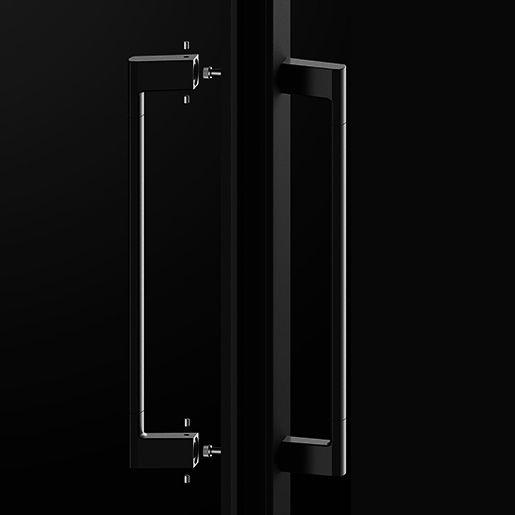
Patio door handles occupy a dual role within architectural design that frequently goes unrecognized. They serve as a primary aesthetic touchpoint, defining the interior visual experience, while simultaneously functioning as a vital mechanical actuator. This mechanism must generate sufficient torque to lift, compress, and lock panels with weights ranging from 80 kg in light residential setups to over 400 kg in commercial lift-and-slide configurations. Specifying a handle based solely on visual appeal overlooks the underlying physics: heavier panels inherently require greater input force to achieve reliable seal compression and lock engagement.
CMECH engineers its portfolio of patio door handles to address this specific load spectrum. Their systems range from the streamlined Metro integrated lock-handle unit—developed for slim-profile doors and screen sashes—to the Milan turn handle, machined from high-strength aluminum alloy for substantial panels 37 mm thick and above. By calibrating each handle family to designated torque requirements, cycle frequencies, and security ratings, the manufacturer provides targeted sliding door hardware solutions for varied structural demands.
Why Door Weight Is the First Variable in Handle Selection
The relationship between panel mass and operational force dictates hardware performance. Every additional kilogram of glass and frame weight increases the resting friction at the roller-track interface and amplifies the compression resistance of the perimeter gasket. Consequently, patio door handles must deliver incrementally higher torque through the internal spindle and gearbox to secure full lock engagement on heavier doors.
When sliding door hardware solution is underspecified for a given panel weight, occupants frequently compensate by applying excessive manual force. This overcompensation can overload the spindle bore, strip drive-gear teeth, or permanently deform the handle body. Such a mechanical failure cascade typically presents initially as a sensation of stiffness, which is often misattributed to the door rollers rather than the handle linkage, delaying necessary corrective action until the internal gearbox sustains irreversible damage.
Integrated Lock-Handle Systems: Form and Function in One Module
Traditional patio door hardware configurations routinely separate the handle, the lock cylinder, and the drive gearbox into distinct components mounted along different positions on the sash. This separation can create mechanical tolerance stacks, add visual clutter to the frame, and introduce snag hazards where standard lock mechanisms protrude into the pedestrian passage zone.
CMECH addresses these architectural constraints with the Red Dot Award-winning Metro Series handle, which incorporates the handle, lock, and drive into a single 30 mm ultra-slim unit. Featuring a linear ball-bearing mechanism tested beyond 100,000 cycles, this consolidated design reduces the mechanical gap between handle rotation and lock-point deployment. The mechanical advantage generated at the grip translates directly into uniform seal compression without the energy losses typically associated with intermediate linkages or misaligned cams.
Torque Transmission: Spindle Diameter and Gearbox Architecture
The spindle serves as the critical torque-transfer element connecting the handle to the transmission rod. A standard 7 mm industry spindle often deflects measurably under the heavy torsional load required to compress dense weather‑stripping. This deflection produces angular backlash—perceived by users as mechanical slop—which accelerates wear within the handle seat and the gearbox bore.
To support demanding applications, CMECH sliding door hardware solution utilizes an upgraded 10 mm spindle, delivering superior torsional rigidity and stable operation. Furthermore, the Milan Series handle utilizes a primary mounting screw rated to withstand 2,000 N of force, actively resisting long-term wobble. Meanwhile, the Metro Series handle employs its integrated linear ball-bearing mechanism to distribute operational forces evenly across the handle body, reducing peak stress concentrations and extending cycle life.
Cycle Durability Under Rated Load
Evaluating handle cycle counts requires testing under loaded conditions rather than standard no-load bench operations. The real-world friction and compression forces present in an actual installation increase mechanical wear on patio door hardware solution significantly. Hardware ratings must reflect the physical resistance generated by heavy sashes and dense weather-stripping to be considered architecturally reliable.
CMECH validates its hardware assemblies with representative seal‑compression load conditions. The Metro Series handle is tested beyond 100,000 operational cycles, while the Recessed Handle with T‑Drive undergoes rigorous 30,000‑cycle durability testing. Performing evaluations under loaded‑condition test setups helps the published operational‑life figures reflect real‑world behaviour instead of idealized showroom‑only performance.
Security Engineering in Handle-Integrated Locks
An integrated handle-lock system needs to resist pry-bar attacks and forced-entry manipulation without relying on bulky external hasps or surface-mounted deadbolts. External additions typically disrupt the clean, flush aesthetic expected in modern patio door designs, presenting a conflict between building security and interior design intent.
To provide security without compromising visual refinement, the CMECH Recessed Handle with T-Drive incorporates a patented ball-bearing locking mechanism. This specialized internal engineering withstands external prying forces exceeding 100 N. It delivers robust anti-theft performance from within a snag-free, flush-mounted profile that maintains clear passage width and preserves uninterrupted interior sightlines.
Matching Handle Profile to Door Configuration and Load Class
Different patio door architectures impose highly specific handle constraints. Openings featuring integrated screen-sashes require ultra-slim handle profiles to avoid physical interference with the secondary leaf. Conversely, heavy-duty lift-and-slide configurations demand handles capable of generating substantial torque to elevate panels weighing between 200 kg and 450 kg before horizontal translation can occur (note: the handle families below are engineered for standard gliding patio‑door systems, not for lift‑and‑slide setups).
CMECH aligns its patio door hardware families with these distinct mechanical envelopes. The 30 mm Metro Series handle is engineered for screen‑sash and narrow‑profile applications where operating clearance is highly restricted. The Milan Series handle, built from high‑strength aluminium, is specified for sash profiles with thickness above 37 mm, including heavy‑weight door panels. For applications prioritizing anti‑pry resistance and spatial economy, the Recessed Handle with T‑Drive offers a highly capable low‑profile solution.
Aesthetic Standardization and Multi-Unit Procurement
Specifying sliding door hardware solution from a single product family across a multi-unit development provides notable logistical and design benefits. It ensures consistent finish tones, uniform tactile feedback, and highly reliable spare-part compatibility for facility management teams over the lifecycle of the building.
Consolidating hardware procurement through a provider like CMECH also streamlines technical documentation for construction teams. This standardized approach helps reduce the installation-error rate that frequently occurs when contractors are forced to navigate unfamiliar hardware geometries and varied routing instructions across mixed-vendor specifications.
All hardware specifications, performance data and material parameters are sourced from CMECH official product manuals and certified test reports.
