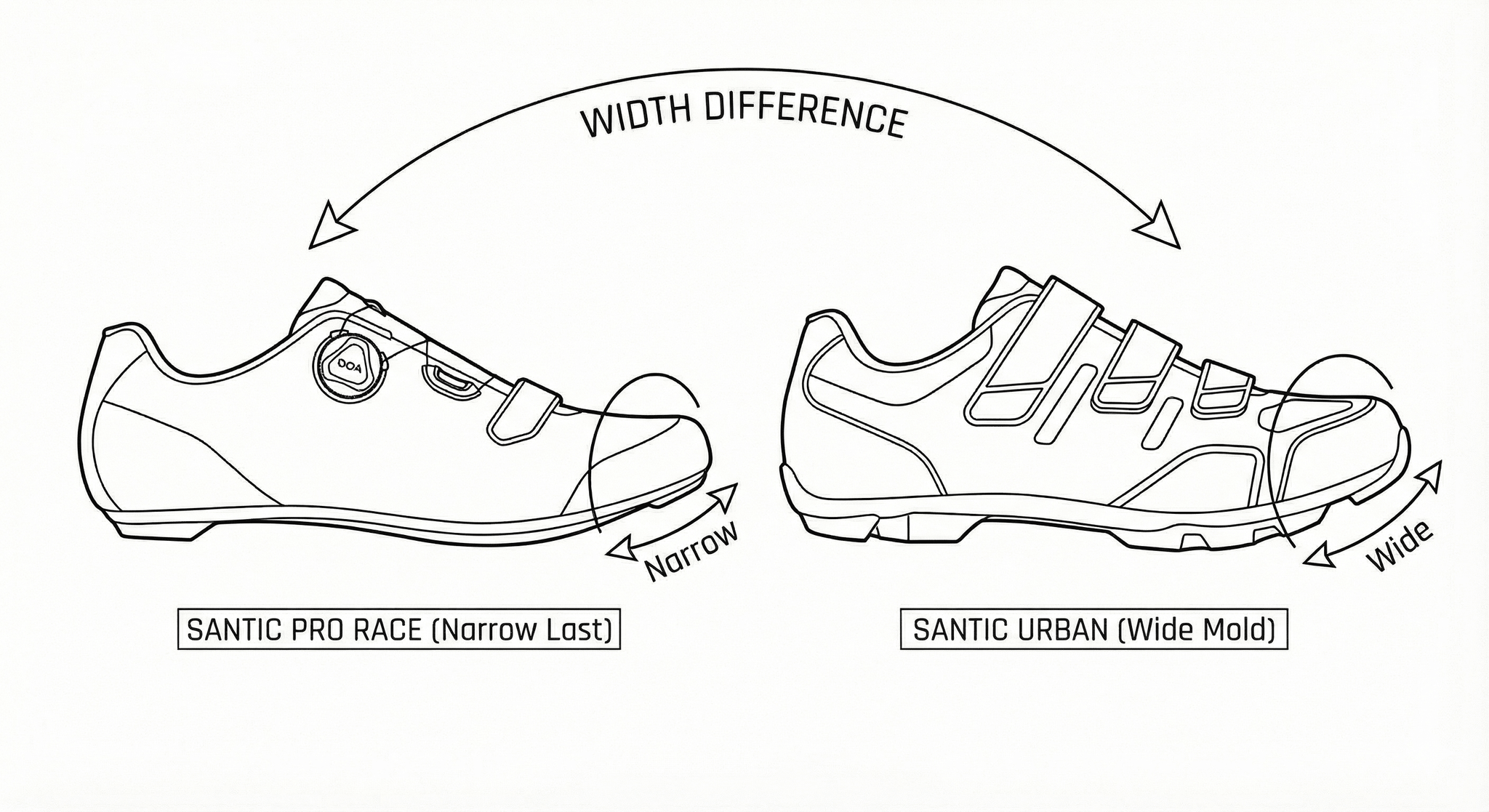
A new mountain-bike shoe can feel wrong for several different reasons, and treating every problem as a simple size error often hides the real cause. Pressure at the toes may come from insufficient length or a compact toe box; numbness over the top of the foot can involve instep volume or closure tension; heel movement can reflect retention geometry; and discomfort around the pedal can be connected to cleat compatibility or foot position rather than the last itself.
Troubleshooting works best when symptoms are separated by location and then traced back to measurable dimensions or shoe structure. The starting point is therefore not a guess about whether a rider “needs one size up.” It is a comparison between foot length, foot width, toe-box volume, instep space, heel retention, and the intended pedal system.
Measure the Foot Before Blaming the Size Label
Measurement establishes whether the basic dimensions are plausible before any adjustment to closure or cleat position. A practical method for how to measure foot length places a sheet of paper against a wall, has the rider stand with the heel lightly touching the wall, marks the longest toe, and measures the distance from the wall edge to that mark.
Because left and right feet can differ, the sizing baseline can be based on the longer foot. Width is checked separately while standing by marking the widest points of the forefoot and measuring between them. Those two dimensions are more informative than an EU number alone because different models can use different lasts and internal volumes. Triathlon shoes may carry the same printed size while using a different opening, upper volume, and retention geometry.
Size Numbers Do Not Define Shoe Shape
The same printed size can fit differently in an MTB model and in triathlon shoes because their entry and retention structures serve another riding context. A triathlon model may use a wide entry opening and transition-oriented closure, while a Pro Race MTB design may use a more compact last and a highly rigid sole.
Fit troubleshooting therefore begins by separating “size” from “shape.” If measured length is appropriate but the forefoot feels compressed, width or toe-box volume deserves attention. If the forefoot is comfortable but the heel lifts, the problem lies elsewhere. Symptom location points toward the part of the shoe that governs that area. The procedure for how to measure foot length confirms the longitudinal dimension before those shape differences are assessed.
Match the Symptom to Volume, Retention, and Structure
Pressure over the top of the foot points to a different variable than toe clearance. Knowing how to measure foot length remains useful, but tightness or numbness on the instep may indicate that the shoe’s upper volume or closure position is not well matched to a higher instep.
Four- and five-star instep-adjustability ratings correspond to upper volume and dial placement configured to accommodate a higher instep with fewer concentrated pressure points. Toe-box space, forefoot width, and heel containment should be considered independently, because loosening a closure to relieve one area may create movement in another.
Triathlon shoes show a different way of managing entry and retention. Santic’s NF model uses a wide opening, quick hook-and-loop entry, 3D mesh, outsole ventilation, and an EVA insole so the foot can enter quickly after the swim and still be supported during the bike leg.
An MTB shoe used over rough ground may place more emphasis on a secure heel, protective upper, and controlled forefoot position. The contrast shows that fit is not a universal sensation produced by size alone; it results from the last, upper, closure, insole, heel structure, and intended riding movement working together.
Check the Pedal Interface After Basic Fit Is Confirmed
Pedal-interface checks belong later in the diagnostic sequence. After foot length and width have been measured to establish the basic dimensional fit, new MTB footwear also has to match the chosen pedal and cleat arrangement.
Santic’s Alps model uses a full-carbon outsole with stiffness index 14, an EVA cushioned insole, TPU/microfiber/mesh upper, laser ventilation, TPU toe protection, replaceable forefoot spikes, and MTB cleat compatibility in 2- or 4-bolt formats including SPD. A highly rigid sole can make small positioning differences more noticeable because the platform itself does not deform much around the foot.
That is another reason triathlon shoes cannot be used as a direct fit reference for every MTB model. Their closure speed, upper ventilation, sole stiffness, and cleat environment can differ substantially. A rider who feels forefoot pressure only after clipping in may need to distinguish shoe volume from pedal-interface position; a rider who feels heel movement while walking may need to examine retention rather than cleat choice.
The most useful troubleshooting order is measurable fit first, localized pressure second, heel and closure behavior third, and pedal compatibility after those variables are understood. That sequence prevents one symptom from being blamed on the wrong part of the system.
Fit problems in new MTB footwear become easier to solve when they are treated as separate mechanical questions instead of one vague sizing complaint. Length and width establish the dimensional baseline, toe-box and instep volume explain many pressure patterns, heel structures and closures control internal movement, and the cleat interface adds another variable once the shoe is on the bike.
Santic’s sizing method and model differences make that hierarchy visible. A nominal size can start the process, but it cannot finish it. The final fit depends on where the foot needs room, where it needs restraint, and how securely the shoe connects that foot to the selected pedal system. A measured, symptom-by-symptom sequence also avoids unnecessary changes to a shoe that may already be correct in several other dimensions.
