Choosing between multimode and single-mode fiber connectivity depends on more than the distance between two network devices. Fiber type, optical compatibility, installation costs, and future expansion plans all influence how efficiently Ethernet traffic moves across a network. Understanding these differences helps network planners determine whether a gigabit media converter multimode configuration fits the deployment or whether single-mode fiber offers a more suitable path.
How Multimode and Single-Mode Fiber Carry Optical Signals
Multimode fiber has a relatively large core, allowing light to travel along multiple optical paths. These paths can arrive at slightly different times, creating modal dispersion that limits the practical bandwidth-distance performance of the link.
Single-mode fiber has a much smaller core. This smaller core supports a single propagation mode, reducing modal dispersion and making it suitable for longer transmission distances and high-capacity network applications.
The difference affects more than cable construction. Multimode fiber is frequently found in buildings, server rooms, and campus networks where links are relatively short. Single-mode fiber is common in connections between buildings, telecommunications infrastructure, and geographically separated facilities, although the appropriate choice always depends on the optical equipment and network requirements.
Transmission Distance, Bandwidth, and Optical Compatibility
Transmission distance is often the first practical distinction considered during network planning. Multimode links can support gigabit Ethernet over distances that vary with the fiber grade, wavelength, and transceiver specifications. Single-mode fiber can support much longer connections, depending on the optical standard and equipment.
Single-mode fiber can support much longer connections, often extending several kilometers or more depending on the optical standard and equipment. Some deployments use links spanning tens of kilometers, but the achievable distance depends on transmitter power, receiver sensitivity, connector losses, and the optical budget rather than fiber type alone.
Optical compatibility deserves equal attention. A converter designed for multimode fiber must use an appropriate optical interface and wavelength, while single-mode operation requires compatible optics and fiber. Network engineers should verify the Ethernet standard, connector type, wavelength, and supported distance at both ends before purchasing equipment.
Installation Costs and Practical Network Planning
Multimode fiber may be economical for short links because compatible optical modules can cost less in certain configurations. Existing multimode cabling can also reduce installation work when a building already has suitable infrastructure. However, the total cost depends on cable availability, labor, connector quality, and the requirements of the chosen transceivers.
Single-mode fiber can offer greater distance flexibility and may be advantageous when new cabling must support future network expansion. Its optical modules may have different pricing, and the overall installation cost depends on the equipment ecosystem rather than a universal cost advantage for either fiber type.
Maintenance planning should account for both media and conversion equipment. Fiber connectors need suitable cleaning, cable bends must remain within specified limits, and link failures require checks of optical power and Ethernet settings. A properly documented installation makes troubleshooting easier regardless of whether the network uses multimode or single-mode fiber.
The Role of Media Converters in Gigabit Ethernet Networks
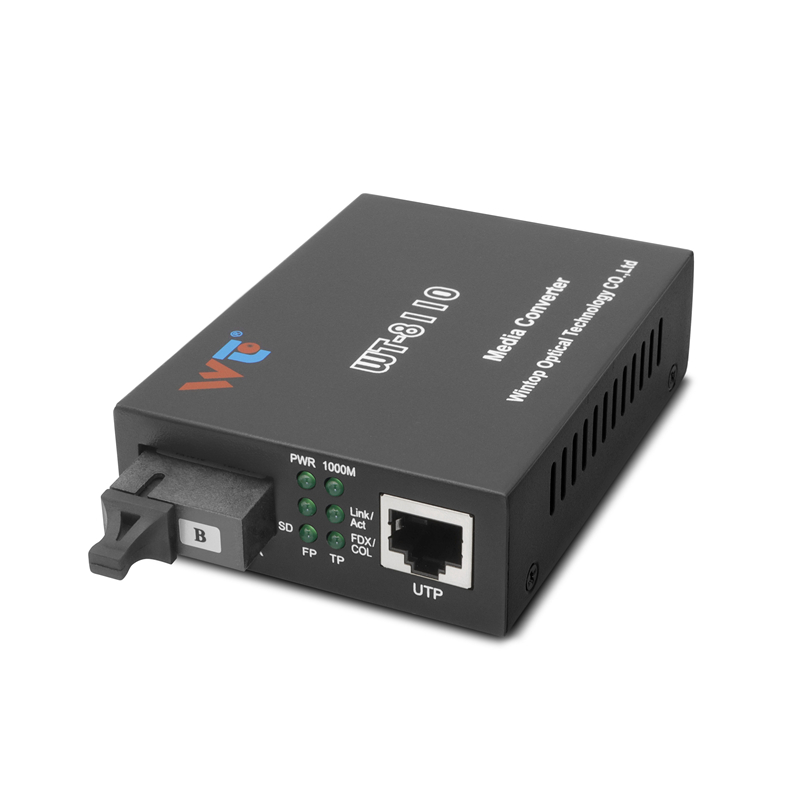
Media converters bridge different physical transmission media while allowing compatible Ethernet equipment to communicate. A typical application converts copper Ethernet to fiber, extending connectivity beyond the practical reach of a standard copper Ethernet run while providing electrical isolation between the two physical interfaces.
For gigabit deployments, the relevant specifications include 10/100/1000BASE-T support on the copper side, the appropriate fiber interface on the optical side, maximum transmission distance, duplex operation, and compatibility with connected switches or routers. Link indicators and diagnostic features can also simplify installation and fault identification.
WINTOP offers 10/100/1000BASE-T copper-to-fiber media converters with a built-in SC fiber connector and transmission distances of up to 20 km, depending on the supported configuration. These units can operate as standalone desktop devices or be installed in a media converter rack for centralized deployment. The specified distance and fiber compatibility should be checked against the exact model before installation.
How to Select the Right Converter for a Specific Deployment
Start by documenting the existing network: the copper Ethernet standard, fiber type, required distance, connector, and available equipment at each endpoint. If multimode cable is already installed and the connection falls within its supported range, replacing it with single-mode fiber may add unnecessary expense and installation work.
For new infrastructure, consider the expected distance and potential expansion requirements together. A short connection inside a building may favor multimode, while an inter-building link or a route requiring greater reach may favor single-mode. The decision should also account for the transceivers available in the network and any planned upgrades to Ethernet speeds.
Before deployment, confirm that both endpoints support the same Ethernet rate and compatible optical specifications. Check the converter’s power requirements, operating temperature range, mounting arrangement, and environmental suitability as well. A successful link depends on the complete connection—from the switch and converter through the fiber path to the receiving device—not simply on the converter’s advertised maximum distance.
Conclusion
Multimode and single-mode media converters serve similar purposes, but their optical characteristics make them suitable for different network conditions. Multimode is often practical for shorter links using existing building infrastructure, whereas single-mode offers greater reach for connections that extend farther or require more distance flexibility.
A gigabit media converter multimode solution makes sense when its fiber type, optical interface, and distance rating match the network’s actual needs. WINTOP provides Ethernet-to-fiber conversion options for both standalone and rack-based installations, giving network planners configurations to evaluate against their deployment requirements. Contact WINTOP to discuss the appropriate media converter specifications for a particular network design.
