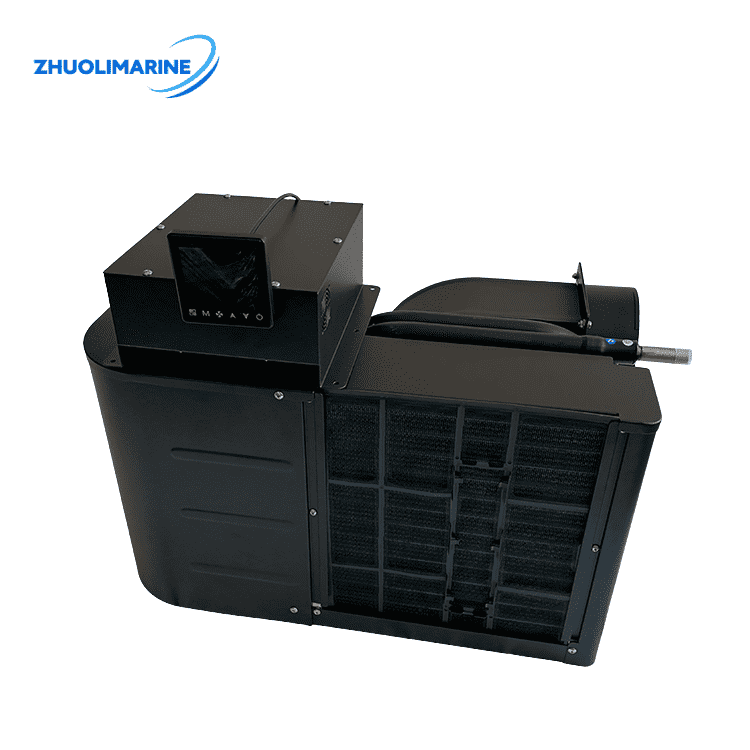
Outfitting single-cabin vessels—such as day cruisers, center consoles with cuddy berths, pocket yachts, and commercial workboats—presents distinct engineering challenges for climate control. Unlike multi-deck luxury yachts with dedicated machinery rooms, single-cabin craft possess limited interior volume, minimal insulation against hull solar gain, and tightly constrained bilge or locker storage spaces. Installing an oversized cooling system creates short-cycling issues that fail to extract cabin humidity, while an undersized unit leads to continuous mechanical strain without achieving target temperatures.
For marine equipment distributors, boat builders, and vessel owners operating across North America, Europe, and the Middle East, selecting the appropriate cooling hardware requires balancing thermal output, electrical draw, physical footprint, and environmental durability. Modern marine climate engineering provides compact, highly integrated solutions designed specifically to deliver efficient cooling and heating without sacrificing valuable cabin space or draining onboard power reserves.
Essential Selection Criteria for Marine AC Units in Compact Cabins
Determining the exact cooling requirements for a single-cabin boat involves evaluating total cabin volume, glass surface area, ambient seawater temperature, and solar exposure. Smaller berths generally require 9,000 BTU systems, whereas larger enclosed pilothouses or open-saloon cruisers demand capacities reaching 12,000 BTU to 16,000 BTU. Choosing appropriately sized marine ac units can support faster cabin temperature pull-down after the vessel has been exposed to direct sunlight, while also supporting humidity control.
Electrical power management is another primary consideration for single-cabin vessels that rely on battery banks, auxiliary generators, or solar arrays rather than continuous shore power. Traditional fixed-speed air conditioners produce high starting current spikes that can trip marine circuit breakers or deplete inverter battery systems rapidly during continuous cycling.
Variable-frequency inverter technology solves this operational hurdle through intelligent soft-start logic. By gradually stepping up compressor speeds, inverter-driven marine ac units can reduce starting current spikes during activation. Furthermore, full compatibility across AC 110V/220V power supply networks and native DC 12V/24V/48V battery setups allows boaters to run air conditioning directly off lithium battery banks during overnight anchorages without operating noisy diesel generators.
Because marine cooling systems use seawater to extract heat from refrigeration circuits, material durability dictates long-term operational lifespan. Prolonged raw water exposure can increase corrosion risk for unsuitable materials and may contribute to additional maintenance requirements over time. High-performance climate systems incorporate full-titanium alloy coaxial condensers, which can provide strong resistance to chloride-related corrosion and pitting in saltwater applications in high-salinity warm waters. Additionally, a heavy-duty 304 stainless steel chassis with an integrated stainless steel drain pan helps collect and manage condensate while reducing moisture exposure around the unit beneath seating lockers.
In single-cabin vessel configurations, the air conditioning system is frequently installed directly beneath berths or inside seating lockers within the main living space. Low-noise operation is therefore an important consideration for onboard passenger comfort. Advanced compressor damping, whisper-quiet centrifugal blowers, and vibration-isolating mounting pads can help create a more comfortable cabin environment during overnight use.
Featured Engineering Solution: Integrated Inverter Marine Air Conditioners
To meet the practical installation and operational requirements of single-cabin craft, integrated inverter marine air conditioners provide compact and practical climate control. Ranging from 9,000 BTU up to 25,000 BTU, these self-contained heating and cooling systems feature a minimal physical footprint designed for seamless integration into tight lockers, bilge spaces, or under-berth compartments across diverse hull shapes.
Built with full-range variable-frequency inverter compressors supporting both AC 110V/220V power connections and native DC 12V/24V/48V battery architectures, these systems provide flexibility for different onboard power setups. Each unit features a full-titanium alloy coaxial tube condenser for strong corrosion resistance in saltwater environments, paired with a robust 304 stainless steel chassis and an integrated drain pan to ensure structural longevity.
Equipped with an IPX4 splash-proof rating, soft-start low inrush current protection, quiet acoustic performance, and intelligent Wi-Fi mobile app connectivity for convenient remote temperature control, these systems provide flexible onboard climate control. Backed by a 1-year warranty and dedicated factory technical support, these units offer a reliable climate solution for international commercial outfitters, brand partners, and equipment distributors.
Installation and Maintenance Considerations
Installation conditions should also be evaluated before selecting marine AC units for a single-cabin vessel. The available space needs to accommodate the equipment while leaving sufficient room for air circulation, seawater connections, drainage, and routine service access. Installing the unit in an overly confined location may make future inspection or maintenance more difficult, even when the physical dimensions appear suitable.
For distributors and boat builders, maintenance requirements are also worth considering during procurement. Corrosion-resistant heat exchangers, stainless steel structural components, and accessible installation layouts can simplify long-term service work. Warranty coverage and technical support should also be reviewed before purchase, particularly when the same equipment may be installed across different vessel models or supplied to multiple end users.
Selecting the Right Marine HVAC Platform for Your Vessel
Selecting a suitable cooling system for a single-cabin boat involves evaluating cooling capacity, power source availability, material corrosion resistance, and physical space. Prioritizing variable-frequency inverter units with corrosion-resistant materials and compact designs can support efficient operation, low-noise nighttime use, and practical long-term maintenance in marine environments.
As a specialized manufacturer of marine climate control equipment, ZhuoliMarine supplies inverter HVAC systems for commercial vessels, private yachts, and international marine equipment distributors. Its range of voltage configurations and corrosion-resistant construction supports different vessel installation requirements. Contact the ZhuoliMarine technical sales team to discuss suitable marine climate control solutions for upcoming vessel projects or distribution needs.
.
