Deploying automated guided vehicles (AGVs) across manufacturing facilities requires careful coordination of vehicle design, payload capacity, navigation, and safety systems. Engineers must consider aisle dimensions, floor conditions, travel distances, and material transfer points when planning mobile robot operations. These factors directly influence chassis dimensions, drive selection, and battery requirements.
Before expanding a fleet, manufacturers should validate the interaction between drive components, vehicle controllers, and fleet management software. Selecting suitable motion hardware and establishing consistent commissioning procedures help ensure that AGVs operate reliably within existing production and warehouse workflows.
Architectural Planning and Chassis Compactness Integration
Optimizing internal space utilization remains a major consideration when integrating mobile robotics into crowded factory floor environments. Vehicle designers favor highly integrated motion hardware to reduce chassis volume and maximize space for auxiliary payload lifting mechanisms or power storage units.
- Compact powertrain designs reduce overall vehicle dimensions for tight aisle navigation.
- Highly integrated drive modules simplify internal wire routing and assembly routines.
- Standardized mechanical mounting interfaces accelerate custom chassis development phases.
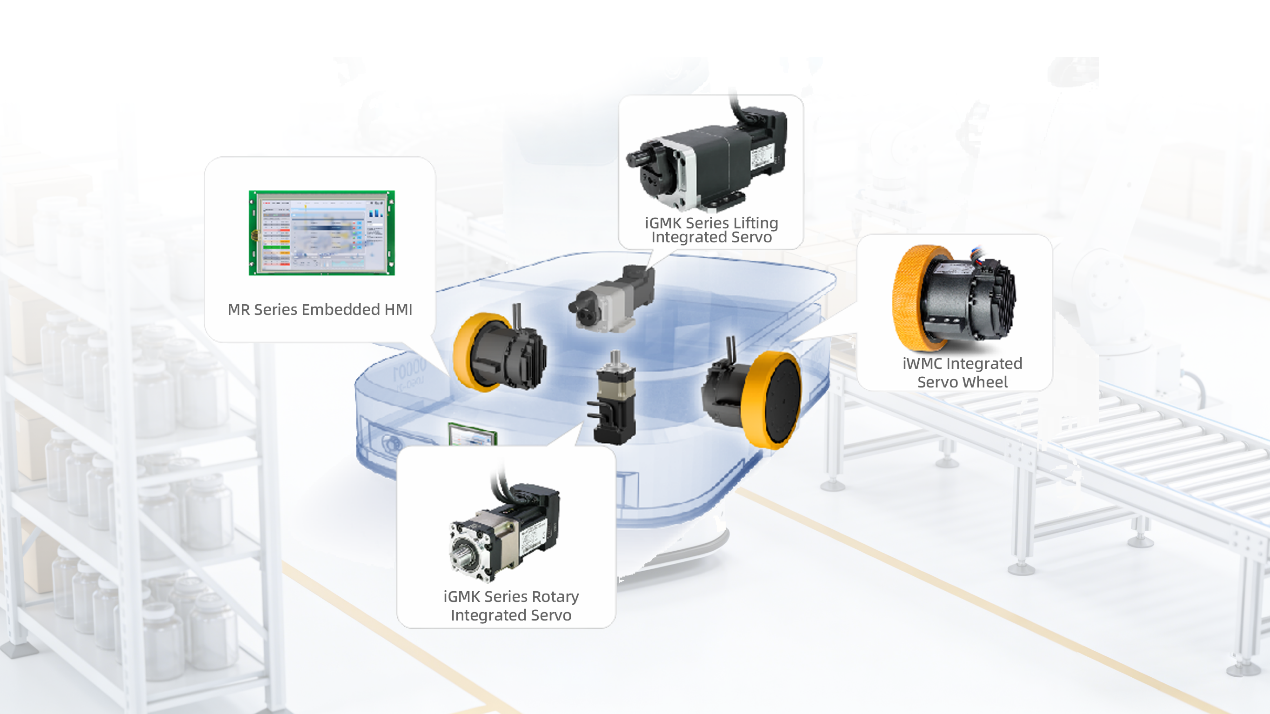
Implementing specialized motion control for industrial robotics enables equipment developers to streamline vehicle chassis construction while maintaining structural rigidity. Utilizing integrated motion packages—such as the Kinco iGMK Integrated Servo Reducer Motor—unites servo drives, motors, and gearboxes into compact units, allowing engineers to bypass complex multi-component bracket fabrications.
Furthermore, minimizing internal wiring harnesses reduces electromagnetic interference risks and lowers mechanical failure rates caused by continuous structural vibration. Compact internal layouts grant design teams the flexibility required to build low-profile vehicles capable of sliding easily under standard material pallets and transport carts.
Navigation Reliability and Motion Synchronization Across Fleets
Accurate vehicle positioning depends on consistent motion feedback, wheel calibration, and communication between the drive system and navigation controller. In high-density warehouses and manufacturing facilities, small wheel-speed errors can accumulate over repeated travel cycles and affect automated docking accuracy.
- Encoder feedback provides wheel rotation information for odometry and motion monitoring.
- One-to-many communication interfaces simplify cabling and commissioning across connected motion components.
- Appropriate acceleration and deceleration profiles help maintain wheel traction on different floor surfaces.
Deploying a reliable AGV robot fleet requires coordination between wheel drives, vehicle controllers, and navigation software. Kinco’s iWMC Integrated Servo Wheel Module combines a servo drive, servo motor, planetary gearbox, and polyurethane wheel in a four-in-one design. This configuration reduces the number of separately installed drive components and simplifies vehicle integration.
Wheel diameter, gearbox ratio, and vehicle geometry should be calibrated during commissioning to improve odometry accuracy. Engineering teams should also test turning, stopping, and docking performance under representative payload conditions. Kinco’s AGV/AMR motion control solution uses a one-to-many communication interface to simplify cabling and commissioning across the integrated system.
Environmental Safeguards, Ingress Protection, and Thermal Design
Factory environments expose mobile equipment to dust, water splashes, temperature changes, and other operating conditions that can affect electronic and mechanical components. Selecting appropriate protection ratings and cooling configurations is therefore important when specifying drive modules for industrial vehicles.
- IP54-rated drive modules provide protection against dust ingress and water splashes.
- Operating temperature and humidity limits should be checked against the actual installation environment.
- Appropriate cooling arrangements help manage heat generated during continuous motor operation.
Kinco’s iWMC and iGMK integrated drive products both feature IP54 protection ratings. Their specified operating temperatures differ: the iWMC series operates from 0°C to +40°C, while the iGMK series is rated from -20°C to +40°C without freezing. These differences should be considered when selecting components for facilities with varying ambient conditions.
Cooling requirements also depend on the motor load, duty cycle, and available installation space. The iWMC series supports natural and body-assisted cooling, while the iGMK series uses natural cooling. Adequate clearance around the drive assembly and suitable mounting conditions help engineers evaluate thermal performance under actual operating loads.
IP54 protection does not imply suitability for high-pressure washing, immersion, or every chemical exposure condition. Equipment designers should assess cleaning procedures and environmental contaminants before finalizing the enclosure and installation configuration.
Power Efficiency, Battery Runtime, and Safety Compliance
Optimizing electrical efficiency extends operational battery life per charge cycle, maximizing total vehicle uptime across active production shifts. Choosing high-efficiency brushless servo systems lowers continuous current draw during constant-speed transit phases.
- Low-voltage DC winding designs optimize energy draw from onboard battery supplies.
- Safe Torque Off (STO) support enables hardware-level motor power cutoff during emergencies.
- Low-power standby modes conserve battery energy during scheduled station dwell times.
Incorporating hardware-based Safe Torque Off capabilities ensures compliance with international machine safety standards while maintaining active fieldbus communication. Isolating power outputs instantly upon safety sensor triggers allows operators to clear travel pathways without losing vehicle position context or restarting control networks.
Furthermore, predictable current draw profiles allow fleet management software to schedule battery charging routines accurately. Preventing unexpected voltage drops protects sensitive onboard sensors, safety laser scanners, and navigation computers against sudden system reboots during heavy acceleration cycles.
Establishing Scalable Infrastructure for Long-Term Mobile Automation
Expanding an AGV fleet requires consistent component selection, standardized communication interfaces, and sufficient capacity within the existing facility layout. Modular motion components can simplify vehicle configuration and make it easier to introduce additional transport units as production and material handling requirements change.
Before expanding operations, manufacturers should evaluate payload capacity, wheel traction, gearbox ratios, drive voltage, communication compatibility, and maintenance access. These factors help determine whether existing vehicle configurations can accommodate higher workloads or whether different drive assemblies are needed.
Kinco‘s AGV/AMR motion control solution combines integrated servo wheels, geared motor modules, and embedded HMI components. The iWMC and iGMK product families address different mobile robot drive requirements, with integrated designs that reduce separate component installation. Such configurations give equipment manufacturers practical options when developing compact chassis and modular mobile powertrains for industrial material handling.
