Digital workflows have transformed modern dentistry, allowing laboratories and clinics to replace traditional manual fabrication methods with precise additive manufacturing. Among specialized photopolymers, transparent resins have become essential for producing functional, patient-contacting appliances.
Clear materials offer distinct practical advantages beyond simple visual appeal. High optical clarity allows dental practitioners to visually evaluate fit, verify tissue seating, and monitor internal channels during clinical procedures, directly reducing chairside adjustment time.
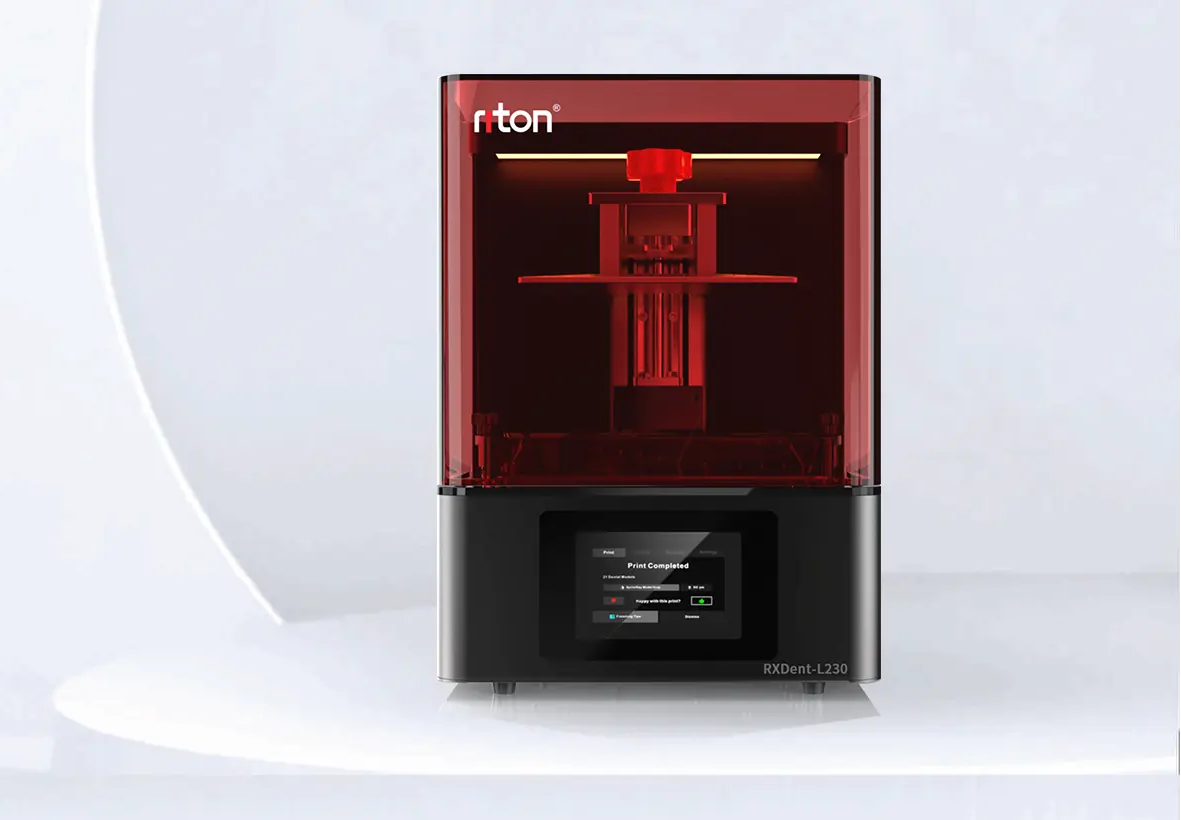
Leveraging transparent photopolymers requires advanced hardware capable of rendering delicate internal structures without optical distortion. High-performance systems, such as the Riton RXDent-L230, combine precise light delivery with high-resolution masking panels to produce stable transparent parts.
Technical Performance of a Clear Resin 3D Printer
Operating a specialized clear resin 3D printer requires strict control over light dispersion and photopolymer cross-linking. Transparent liquid resins allow ultraviolet light to penetrate deeper into underlying layers if exposure parameters are not properly calibrated.
Excessive light transmission through liquid photopolymers causes unwanted over-curing, leading to filled internal channels or distorted guide holes. Modern light engines resolve this challenge by projecting uniform, parallel ultraviolet rays through controlled exposure masks.
An advanced LCD resin 3D printer utilizes a high-density liquid crystal panel to mask light with pinpoint accuracy. Controlling pixel-level exposures prevents light bleeding into adjacent regions, preserving crisp internal geometries and razor-sharp features.
Light distribution exceeding ninety percent uniformity across the platform supports consistent polymerization throughout the resin vat. This structural consistency guarantees that printed clear appliances maintain optical transparency without internal cloudiness during post-curing procedures.
Surgical Guides and Implant Placement
Surgical implant guides represent a critical clinical application for transparent photopolymers. These surgical templates rest directly on patient gums or dentition, directing drill bits along pre-planned angles and depths during computer-guided implant placement operations.
Optical transparency is paramount throughout complex surgical procedures. Clear guides allow clinicians to visually confirm that the appliance is completely seated against soft tissue and teeth, preventing dangerous depth or angular discrepancies during osteotomies.
Transparent drill sleeves also enable continuous visual monitoring of vital irrigation fluids and surgical bur movement. Operating dentists observe coolant fluid flow directly through guide walls, preventing localized bone overheating during delicate drilling sequences.
High-resolution printing guarantees that internal channels match original pre-surgical CAD files within micron-level tolerances. When produced using an advanced LCD resin 3D printer, surgical guides achieve the precise mechanical fit needed to reduce tool wobble.
Occlusal Splints and Nightguards
Clear photopolymers are extensively utilized to fabricate custom occlusal splints, nightguards, and bite planes for treating bruxism and joint disorders. These custom appliances must balance high optical transparency with exceptional wear resistance and durability.
Optical clarity allows dental professionals to evaluate occlusal contact points visually during intraoral fitting. Observing tissue blanching or tooth contact through the clear guard body helps practitioners rapidly identify high spots and streamline chairside adjustments.
Beyond diagnostic advantages, patients strongly prefer transparent splints for aesthetic reasons. High optical clarity ensures that nightguards remain virtually invisible during wear, encouraging better patient compliance throughout extended bite therapy and joint stabilization programs.
Fabricating comfortable splints requires a smooth surface finish to prevent soft tissue irritation. The Riton RXDent-L230 achieves an ultra-smooth surface texture using an 8K display with 30-micron resolution, drastically reducing manual polishing steps.
Orthodontic Appliances and Indirect Bonding Trays
In modern digital orthodontics, transparent resins facilitate indirect bonding trays and clear aligner attachment templates. Indirect bonding trays hold bracket setups in exact digital locations while transferring them simultaneously onto patient enamel during appliance placement.
A transparent indirect bonding tray allows orthodontists to confirm bracket alignment visually and monitor light-curing penetration. Clear resin ensures blue curing light passes through unobstructedly, bonding brackets securely to enamel surfaces without failure risks.
Clear materials are also utilized to print aligner attachment templates. These thin, flexible templates feature precise cavities that hold composite material against specific tooth surfaces during curing, ensuring accurate force delivery throughout tooth movement cycles.
High dimensional stability prevents tray distortion during seating, ensuring every bracket transfers precisely as planned. This extreme placement accuracy drastically shortens clinical bonding appointments and reduces the need for manual bracket repositioning later in treatment.
High-Capacity Production Efficiency
Maximizing return on investment for clear resin applications requires hardware combining high optical resolution with fast batch production. The Riton RXDent‑L230 delivers on these requirements as a complete system, incorporating a specialized 8K monochrome display with high pixel density.
Offering a spacious forming envelope, the system enables commercial laboratories to print multiple surgical guides, nightguards, or bonding trays within a single build cycle. This high batch capacity significantly increases daily laboratory output and profitability.
Rapid printing speeds ranging from one to eight seconds per‑layer accelerate manufacturing cycles without sacrificing edge sharpness. Advanced anti-aliasing technology smoothes pixel steps, ensuring transparent appliances retain outstanding clarity and smooth surface contours natively.
Intelligent slicing software streamlines workflow preparation by automating support generation and exposure profiling for clear photopolymers. Automated pre-processing prevents digital file translation errors and optimizes resin consumption across complex, high-volume production schedules.
Elevating Clinical Precision Through Clear Printing
Transparent photopolymers offer unique functional and diagnostic advantages that opaque materials cannot match. From surgical guides that improve implant safety to discreet splints that enhance compliance, clear resins are vital to modern digital dental practice.
Utilizing a specialized clear resin 3D printer guarantees that digital treatment plans translate into physically accurate appliances. Micron-level manufacturing tolerances eliminate guesswork during clinical seating, protecting patient safety and elevating overall treatment predictability.
Backed by robust hardware engineering and comprehensive service, Riton provides dental facilities with the advanced tools necessary to master clear resin applications, supporting long-term operational growth, elevated lab productivity, and superior clinical treatment success.
