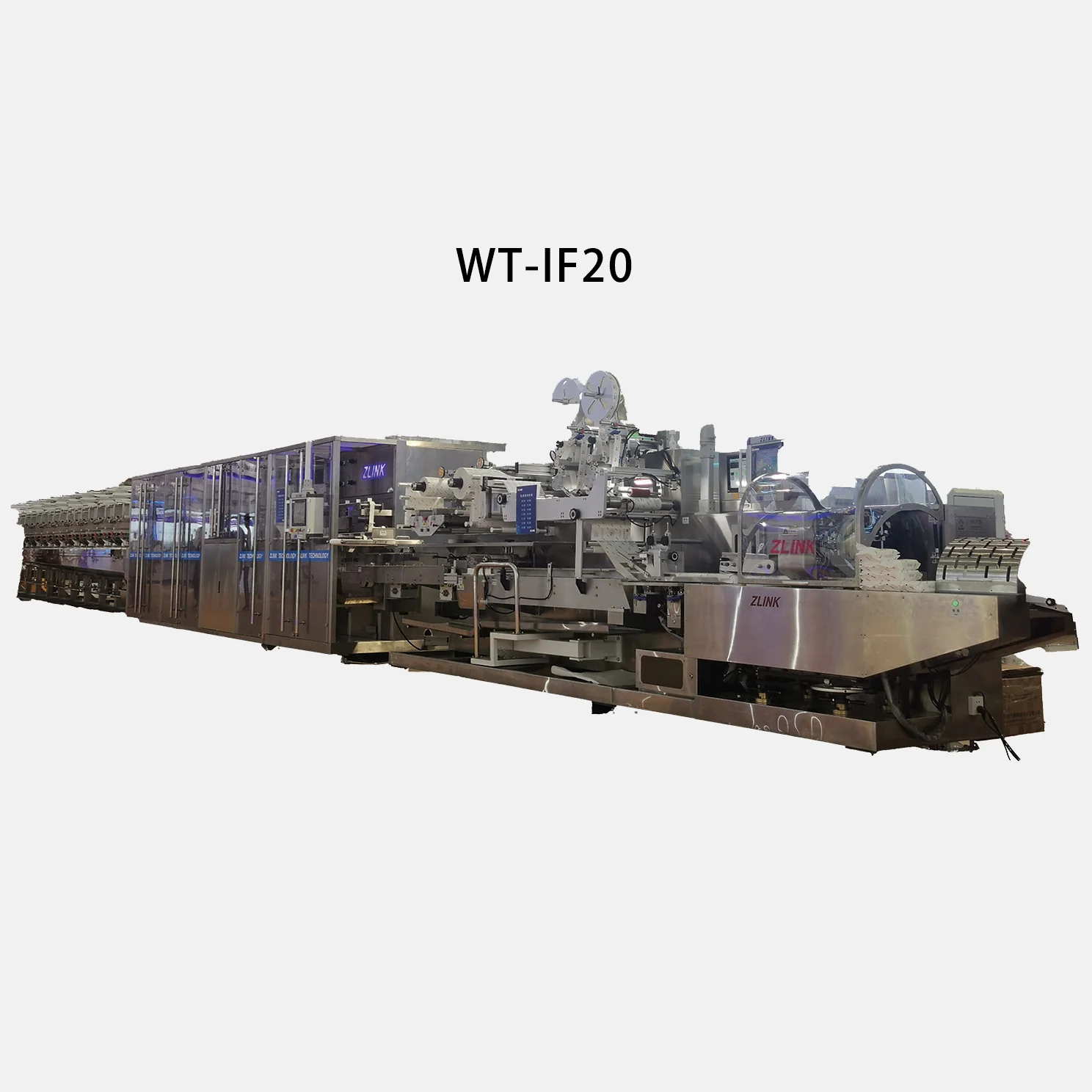
In the fast-paced world of hygiene manufacturing, precision is the dividing line between profitability and waste. When producing baby wipes, the length of each sheet is not just a cosmetic detail; it is a critical specification that impacts packaging efficiency, user experience, and cost control. If a wipe is too long, it may crumple inside the package or jam the sealing jaws. If it is too short, it fails to meet the consumer’s expectations and the labeled specifications. For wet wipes manufacturers sourcing equipment, understanding the mechanics of precision is essential. This article explores the engineering technologies that ensure consistent cut lengths and highlights how a top-tier China baby wipe production line company like ZLINK achieves this through advanced automation.
The Challenge of Non-Woven Fabric
To understand why accuracy is difficult, one must first understand the material. Baby wipes are typically made from spunlace non-woven fabric, often a blend of polyester and viscose, or increasingly, flushable biodegradable materials. Unlike paper or rigid plastic, wet non-woven fabric is elastic. It stretches under tension and shrinks when relaxed. On a high-speed China baby wipe production line, the fabric is pulled through wetting systems, folding plates, and cutting blades at speeds often exceeding 100 meters per minute. If the tension varies even slightly during this journey, the fabric will elongate. A machine might “measure” 200mm of fabric while it is stretched, but once cut and relaxed, that sheet might shrink to 190mm. Conversely, if the fabric slackens, the machine might cut a sheet that is too long. Therefore, ensuring accuracy is not just about the blade; it is about controlling the behavior of the fabric from the moment it leaves the parent roll until it enters the packaging film.
The Role of Servo Motion Control
The heart of modern accuracy lies in the control system. Older mechanical lines relied on gears and chains to synchronize the movement of the fabric with the cutting knife. Over time, these mechanical linkages wear down, introducing “play” or slack that ruins consistency. Leading manufacturers now utilize “Full Servo” technology. For instance, the ZLINK WT-IF series (including the WT-IF20HS, WT-IF40HS, and WT-IF60HS models) employs a multi-axis servo motion controller and full servo motor control. This means that every critical section of the machine—from unwinding to cutting—is driven by an independent computer-controlled motor. These motors communicate in real-time. If the folding section speeds up by 0.1%, the cutting section instantly adjusts to match. This electronic synchronization ensures that the cut length remains precise, regardless of the machine’s operating speed. As a premier China baby wipe production line company, ZLINK integrates these Mitsubishi-based motion control CPUs to guarantee that the theoretical cut length matches the actual physical output.
Mastering Tension: The Unsung Hero
While the servo motors drive the machine, the tension control system manages the material. A high-quality China baby wipe production line must feature an Independent Automatic Tension Control System. This system uses load cells to constantly sense the “pull” on the fabric. If the non-woven roll has a tight spot, the tension spikes. Without automatic control, this would stretch the wipe. However, on ZLINK machinery, the system detects this spike and instantly signals the unwinding servo to feed more material, neutralizing the tension. This occurs in milliseconds. By keeping the tension constant, the fabric’s physical dimensions remain stable, allowing the cutting blades to perform strictly according to spec. Additionally, to maintain this stability during roll changes, ZLINK incorporates a “Non-stop Auto Splicing” feature. This allows the machine to switch from an empty raw material roll to a new one without stopping and without causing the tension fluctuations that usually occur during manual changeovers.
The Cutting Mechanism: Log Saw vs. Rotary
The final step in ensuring length accuracy is the cut itself. In high-speed production, there are generally two methods: rotary die cutting and log saw cutting. For high-volume baby wipe lines, the log saw is often preferred for its clean finish and consistency across multiple lanes. The ZLINK WT-IF Series utilizes a Log Saw with Swing Arm design. Unlike a simple guillotine, the swing arm moves the blade in a synchronized motion with the traveling log of wipes. This ensures a perfectly square cut without stopping the flow of material. This mechanism is critical when running at high capacities—such as the 40 to 60 lanes found on the WT-IF40HS and WT-IF60HS models. The precision of this cut is further supported by the Automatic Web Guider (an optional but recommended feature). This system ensures that the fabric does not drift left or right before it enters the folding and cutting stages. If the fabric drifts, the fold becomes uneven, and the effective length of the wipe changes. The web guider keeps the material perfectly centered, ensuring that every dimension, from width to length, is uniform.
Liquid Accuracy: A Related Critical Metric
While “length” is the primary physical dimension, “wetness” is a dimension of weight that also requires precision. An over-saturated wipe is messy and costly; an under-saturated wipe is dry and ineffective. Accuracy in wetting is achieved through Electronic Flowmeter Control. ZLINK machines offer a precise wetting range of 2.5 to 4.5 times the material weight. This system recycles excess liquid to prevent waste but ensures that the amount of lotion applied to the fabric is exactly what is required. This precision prevents the “soggy bottom package” issue often seen in lower-quality production lines.
Why Certification and Design Matter
A machine can only be accurate if it is stable. Vibration is the enemy of precision. If a machine shakes at high speed, the cut will vary. This is why the structural integrity of the China baby wipe production line is vital. ZLINK builds their equipment to CE safety standards, ensuring robust construction that dampens vibration. Furthermore, they utilize a “Hygiene Grade Design” with 3D sanitary structures. This might seem unrelated to length, but a clean machine runs smoother. The “low point drain out” design ensures that pumps and pipelines are free of residue, preventing clogs or pressure variances that could affect the liquid application and, indirectly, the tension of the wet fabric.
Conclusion
Ensuring the accuracy of wipe length is a complex interplay of mechanics, electronics, and material science. It requires a machine that can “feel” the fabric’s tension and adjust its movements in microseconds. For buyers, the key is to look beyond simple speed claims and investigate the control technologies. Does the line have independent tension control? Is it full servo-driven? Does it use a log saw with a swing arm? ZLINK has established itself as a leading China baby wipe production line company by answering “yes” to these questions. Their WT-IF series represents the pinnacle of accuracy in the market, combining Mitsubishi motion controls with robust mechanical engineering. By investing in a ZLINK China baby wipe production line, manufacturers can ensure that every wipe—from the first to the millionth—measures up to the highest standards of quality and precision.
